

Introduction
Predicting how tall a child will become has fascinated parents and researchers for generations. Height is one of the most visible signs of human development, but understanding future growth is far more complex than simply looking at a child’s current size or the height of their parents.
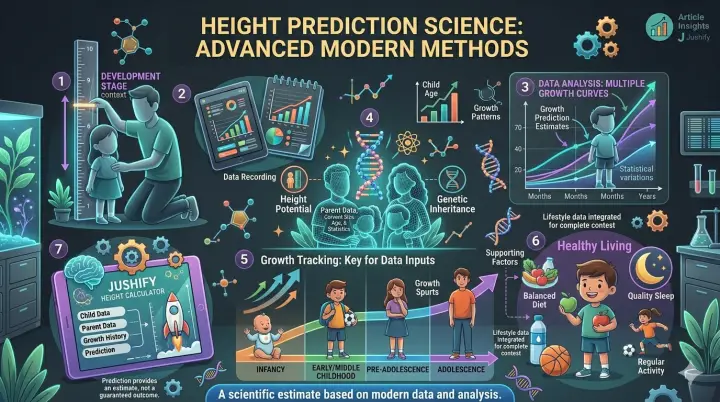
Modern height prediction science combines biology, genetics, mathematics, and statistical analysis to understand growth patterns and estimate future adult height.
Unlike traditional guesses based on simple comparisons, scientific prediction methods analyze multiple factors together, including:
- Genetic information
- Age
- Gender
- Current height
- Weight
- Growth patterns
- Parental height
This approach provides a more meaningful understanding of how different elements contribute to a child’s development.
Height prediction is not about creating a guaranteed future outcome. Instead, it is about using available information and scientific methods to generate an informed estimate based on known growth relationships.
What Is Height Prediction Science?
Height prediction science is the study of methods used to estimate a person’s future adult height by analyzing biological and statistical factors.
Researchers study how different variables influence growth, including:
- Inherited traits
- Childhood development patterns
- Physical measurements
- Population growth data
The goal is to identify relationships between these factors and understand how they contribute to final adult height.
Human growth follows complex biological processes, which means accurate prediction requires more than one simple calculation.
Scientific approaches combine multiple sources of information to create a more complete picture of growth potential.
Why Predicting Height Is Scientifically Challenging
Human height is considered a complex trait because many factors work together.
Unlike characteristics controlled by one simple factor, height involves:
- Thousands of genetic influences
- Hormonal changes
- Development timing
- Environmental conditions
- Lifestyle factors
Two children with similar backgrounds can still experience different growth outcomes.
This variation makes height prediction challenging and explains why modern methods focus on probability and data analysis rather than certainty.
The 5 Major Scientific Factors Behind Height Prediction
1. Genetics: The Biological Foundation
Genetics is one of the strongest influences on height.
Children inherit genetic information from both parents, which affects:
- Bone growth patterns
- Body structure
- Growth timing
- Height potential
However, height is not controlled by one single gene. Many genetic factors interact with each other.
This explains why:
- Children may differ from their parents in height
- Siblings may have different adult heights
- Family patterns provide useful but incomplete information
Understanding genetics and child height is an important part of modern prediction science.
Genetics provides the foundation, but other factors determine how that potential develops.
2. Growth Measurements and Current Development
Current physical measurements provide important information for prediction models.
Scientists analyze factors such as:
- Current height
- Weight
- Age
- Growth progress over time
A child’s present development helps researchers understand where they are in their growth journey.
For example, the same height measurement may have different meanings depending on whether a child is five years old or fourteen years old.
This is why age and development stage are essential parts of scientific height prediction.
3. Age and Growth Stages
Growth does not happen at a constant speed throughout childhood.
Children move through different development periods:
- Infancy
- Early childhood
- Middle childhood
- Adolescence
- Late teenage development
Each stage has different growth patterns.
During adolescence, hormonal changes may create significant growth periods. However, the timing varies from one individual to another.
Scientific models consider these differences when analyzing future height.
Understanding child growth stages helps explain why age is such an important factor in prediction.
4. Gender-Based Growth Patterns
Gender influences growth patterns, particularly during puberty.
Boys and girls generally experience different timing in:
- Growth spurts
- Hormonal development
- Physical maturation
Scientific prediction methods consider these differences because they affect how growth data should be interpreted.
Using gender as one factor helps create a more personalized understanding of development.
5. Statistical Analysis and Mathematical Models
Modern height prediction relies heavily on statistics.
Researchers use mathematical methods to analyze relationships between different growth variables.
One commonly used technique is Linear Regression.
Linear Regression helps identify patterns such as:
- How parental height relates to adult height
- How current height relates to future development
- How multiple factors interact together
Instead of asking:
“Does this one factor determine height?”
Statistical models ask:
“How do multiple factors work together to influence height?”
This approach creates a more realistic prediction system.
Traditional Height Prediction Methods vs Modern Science
Traditional Methods
Older approaches often relied on simple formulas based mainly on parental height.
These methods were useful because genetics plays an important role, but they had limitations.
They often did not consider:
- Current growth measurements
- Age differences
- Development stage
- Multiple influencing factors
Modern Scientific Methods
Modern approaches use broader analysis.
They combine:
- Genetic information
- Physical measurements
- Statistical modeling
- Growth patterns
This allows prediction systems to consider a wider range of information.
The result is a more personalized estimate based on multiple factors rather than a single assumption.
How Linear Regression Improves Height Prediction
Linear Regression is one of the important statistical methods used in predictive analysis.
In simple terms, it identifies relationships between different variables and uses those relationships to estimate future outcomes.
In height prediction, it can analyze connections between:
- Parent heights
- Child height
- Age
- Gender
- Weight
For example, a prediction model can study how children with certain combinations of measurements typically develop over time.
The purpose is not to guarantee a specific result but to create an evidence-based estimate from patterns found in data.
The Role of Growth Tracking in Prediction Science
Growth tracking provides valuable information for understanding development.
By recording changes over time, researchers and parents can observe:
- Growth speed
- Development trends
- Changes between growth stages
A single measurement provides limited information, but repeated observations reveal patterns.
This is why growth tracking and height prediction science are closely connected.
Tracking helps provide the data needed for better analysis.
How Modern Height Prediction Tools Work
Modern digital tools combine scientific concepts with user-friendly technology.
A scientific child height calculator analyzes multiple inputs, including:
- Parent heights
- Child age
- Gender
- Current height
- Weight
After processing the information through statistical calculations, the tool provides an estimated adult height.
The purpose is to help users understand how different growth factors interact.
A modern calculator does not simply guess future height. It applies structured analysis based on relationships found in growth research.
Why Multiple Inputs Matter in Height Prediction
Using multiple inputs improves the quality of analysis because growth is influenced by many variables.
For example:
Parental height provides genetic information.
Age provides development context.
Current height shows present growth status.
Weight provides additional physical context.
Gender helps interpret growth patterns.
When combined, these factors create a more complete understanding of development.
This multi-factor approach is one reason modern prediction systems are more informative than simple height formulas.
Common Misunderstandings About Height Prediction
1- Height Prediction Means Exact Prediction
Scientific prediction provides an estimate, not a guaranteed outcome.
Human biology always includes natural variation.
2- Genetics Determines Everything
Genetics is highly influential, but development also depends on many supporting factors.
3- Current Height Alone Shows Future Height
A single measurement cannot explain the complete growth journey.
4- Prediction Tools Replace Medical Evaluation
Height prediction tools are designed for educational understanding and general awareness. They do not replace professional healthcare guidance.
How Parents Can Use Height Prediction Information
Parents can use prediction information to:
- Understand growth patterns
- Learn about development
- Encourage healthy habits
- Follow long-term progress
The most valuable purpose of height prediction is increasing awareness about how growth works.
It helps parents focus on supporting healthy development rather than worrying about comparisons.
The Future of Height Prediction Technology
As technology improves, growth prediction systems continue becoming more advanced.
Future developments may include:
- Larger growth datasets
- Improved statistical models
- Better visualization
- More personalized analysis
The combination of biology and technology will continue helping people understand human growth more effectively.
Frequently Asked Questions:
What is height prediction science?
Height prediction science studies methods that estimate future adult height using genetics, growth measurements, and statistical analysis.
Is height prediction based only on genetics?
No. Genetics is important, but modern methods also analyze age, gender, current height, weight, and growth patterns.
How does a child height calculator estimate adult height?
A child height calculator combines multiple inputs and uses scientific calculations to estimate adult height based on the provided information.
Why is Linear Regression used in height prediction?
Linear Regression helps identify relationships between multiple variables and improves data-based prediction.
Can height prediction be 100% accurate?
No. Growth is influenced by many biological factors, so prediction provides an estimate rather than a guaranteed result.
Final Thoughts
Height prediction science combines genetics, growth research, and statistical analysis to better understand human development.
Modern methods recognize that height is not controlled by one factor. Instead, it develops through the interaction of inherited traits, growth patterns, lifestyle influences, and biological processes.
By using multiple data points and scientific models, modern prediction tools provide meaningful insights into estimated adult height.
Understanding the science behind prediction helps parents view growth with greater awareness and appreciate the unique development journey of every child.