
Introduction
One of the first things many parents notice about their children is how quickly they grow and change. Height is one of the most visible signs of development, which naturally leads to questions like:
“How much of my child’s height comes from genetics?”
“Will my child be tall if both parents are tall?”
“Can we estimate future adult height?”
The answers are more complex than simply looking at a parent’s height. Genetics plays a major role in determining height potential, but growth is influenced by a combination of inherited traits, development patterns, and environmental factors.
A child’s height is the result of thousands of genetic influences working together with factors such as nutrition, health, sleep, and physical development.
Understanding the connection between genetics and child height helps parents develop realistic expectations and better appreciate the uniqueness of their child’s growth journey.
How Much Does Genetics Influence Child Height?
Genetics is considered one of the strongest influences on human height.
Children inherit genetic information from both parents, including traits related to:
- Bone growth
- Body structure
- Growth patterns
- Hormonal development
- Physical characteristics
However, height is not controlled by a single gene. Instead, many different genes contribute to height, making it a complex inherited trait.
This explains why children often resemble their parents in height but may not match them exactly.
A child receives a unique combination of genetic information, which creates individual growth potential.
7 Important Facts About Genetics and Child Height
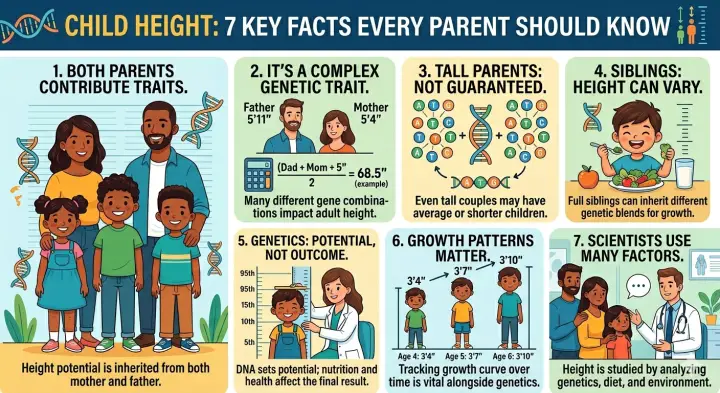
1. Children Inherit Height Traits From Both Parents
A common misconception is that children inherit height only from one parent.
In reality, children receive genetic information from both their mother and father.
These inherited traits influence:
- Growth patterns
- Bone development
- Body proportions
- Adult height potential
Because genetic information comes from both sides of the family, characteristics from grandparents and other relatives may also influence a child’s growth.
This is why looking at the broader family pattern can sometimes provide additional insight.
2. Height Is a Complex Genetic Trait
Height is not controlled by one simple factor.
Researchers have discovered that many genetic variations contribute to height differences between individuals.
These variations influence biological processes such as:
- Bone length development
- Growth hormone activity
- Body composition
- Skeletal growth
Because many genes are involved, predicting height based only on one family member’s height is not always reliable.
Modern scientific approaches analyze multiple factors together to better understand growth patterns.
3. Tall Parents Do Not Always Have Tall Children
Many people assume:
“Tall parents always have tall children.”
While parental height strongly influences genetic potential, it does not guarantee a child’s final height.
Several reasons explain this:
- Children inherit different combinations of genes
- Growth patterns vary between individuals
- Environmental factors influence development
- Puberty timing differs
A child may be taller or shorter than expected based only on parental height.
Genetics provides a foundation, but growth is a complex process.
4. Siblings Can Have Different Heights
It is common for brothers and sisters from the same parents to have different heights.
This happens because each child receives a different combination of genetic information.
Even siblings who grow up in the same household may experience differences in:
- Genetic inheritance
- Growth timing
- Development patterns
- Lifestyle factors
This natural variation shows why human growth cannot be predicted using a single simple rule.
5. Genetics Creates Potential, Not a Guaranteed Outcome
A useful way to understand genetics is to think of it as creating a growth potential.
Genes influence what may be possible, but other factors determine how that potential develops.
For example, healthy growth depends on:
- Adequate nutrition
- Good sleep habits
- Overall health
- Normal development
This relationship between inherited traits and life factors explains why two children with similar genetic backgrounds can still experience different growth outcomes.
6. Growth Patterns Matter Alongside Genetics
Genetics is important, but understanding growth requires looking at how a child develops over time.
Factors such as:
- Current height
- Age
- Growth speed
- Development stage
provide important information about a child’s growth journey.
Parents interested in understanding the complete picture should consider multiple child growth factors rather than focusing only on family height.
Understanding these combined influences is an important part of learning about child growth factors.
7. Modern Science Uses Multiple Factors to Study Height
Because height depends on many influences, researchers use statistical methods to study growth patterns.
Modern analysis can include:
- Parental height
- Child’s current measurements
- Age
- Gender
- Weight
By combining multiple variables, scientists can identify patterns that help estimate future adult height.
This approach is more informative than relying on a single factor.
Genetics vs Environment: What Really Shapes Height?
Although genetics plays a major role, environmental factors also influence growth.
Nutrition
A balanced diet supports healthy development.
Important nutrients include:
- Protein
- Vitamins
- Minerals
- Essential nutrients
Good nutrition helps children reach their natural growth potential.
Sleep
Sleep supports many important body processes during childhood.
Healthy sleep habits contribute to:
- Physical recovery
- Development
- Overall wellbeing
Physical Activity
Regular movement supports:
- Muscle development
- Bone health
- Physical fitness
Activities such as sports and outdoor play contribute to a healthy lifestyle.
Overall Health
Health conditions and general wellbeing can affect normal growth patterns.
Regular monitoring helps parents understand their child’s development.
How Parents Can Better Understand Their Child’s Height Potential
Parents often want to know how tall their child may become in adulthood.
While genetics provides important information, understanding height requires considering several factors together.
A child height calculator can help analyze multiple inputs, including:
- Parent height
- Child’s age
- Gender
- Current height
- Weight
By using scientific calculations and statistical analysis, these tools provide an estimated adult height based on the information provided.
They do not replace professional medical advice, but they can help parents understand how different growth factors work together.
How Modern Height Prediction Tools Combine Genetics and Data
Traditional height predictions often focused mainly on parental height.
Modern prediction methods use a broader approach.
A scientific height prediction tool may combine:
- Genetic information
- Current growth measurements
- Development stage
- Statistical modeling
One commonly used statistical approach is Linear Regression, which identifies relationships between different variables.
For example, it can analyze how parental height and current growth measurements relate to future adult height estimates.
This allows predictions to be based on multiple factors rather than a single assumption.
Why Understanding Genetics Helps Parents Avoid Unrealistic Expectations
Many misconceptions about height come from oversimplifying genetics.
Common assumptions include:
- A tall child will always become a tall adult
- Short parents cannot have tall children
- Height is completely determined at birth
The reality is much more interesting.
Human growth involves thousands of biological interactions. Genetics provides important information, but each child’s development follows its own path.
Understanding this helps parents focus on supporting healthy growth instead of comparing children unfairly.
Common Myths About Genetics and Child Height
Myth 1: Height Comes Only From the Father
Height-related traits come from both parents and involve many genetic influences.
Myth 2: A Child’s Adult Height Can Be Predicted Exactly
No method can guarantee an exact adult height because growth is affected by many biological factors.
Myth 3: Genetics Is the Only Factor That Matters
Genetics is important, but nutrition, health, sleep, and lifestyle also support development.
Myth 4: Siblings Should Have Similar Heights
Siblings can have different heights because they inherit different genetic combinations.
Frequently Asked Questions
Does genetics determine a child's height?
Genetics is one of the strongest influences on height, but other factors such as health, nutrition, and development also affect growth.
Do children always become the same height as their parents?
No. Parents influence height potential, but children inherit unique combinations of genes that can lead to different outcomes.
Can parents predict their child's future height?
Parents can estimate future height using scientific methods that analyze genetics and growth information, but predictions are not guarantees.
How does a child height calculator use genetics?
A child height calculator considers parental height along with other factors such as age, gender, current height, and weight to estimate adult height.
Why are siblings different heights?
Siblings receive different combinations of genes, which can result in different growth patterns and adult heights.
Final Thoughts
Genetics plays a fascinating role in determining child height, but it is only one part of a much larger growth story.
A child’s future height develops through the interaction of inherited traits, development patterns, lifestyle factors, and overall health.
Understanding genetics helps parents appreciate why every child grows differently. Modern scientific tools build on this knowledge by combining genetic information with other growth factors to provide meaningful insights.
By learning how genetics and development work together, parents can better support their child’s growth journey and understand the science behind estimated adult height.