
Introduction
Every child follows a unique growth journey. From early childhood to adolescence, children experience continuous physical changes that reflect their development, health, and biological progress.
For parents, understanding whether their child is growing normally can sometimes feel confusing. A single height measurement does not tell the complete story. What matters more is observing growth patterns over time.
This is where growth tracking becomes valuable.
Growth tracking allows parents to monitor changes in height, weight, and development patterns throughout childhood. By observing these changes consistently, parents can better understand their child’s progress and identify important trends.
Modern growth tracking combines traditional measurements with scientific analysis. Today, parents can use digital tools to organize growth information, compare development patterns, and understand how different factors contribute to future growth.
Understanding growth tracking is not about predicting every detail of a child’s future. It is about gaining meaningful insights into development and supporting healthy growth habits.
What Is Growth Tracking?
Growth tracking is the process of monitoring a child’s physical development over time.
It involves recording important measurements such as:
- Height
- Weight
- Age-related changes
- Development progress
The purpose of growth tracking is to understand how a child is growing rather than focusing on one specific measurement.
For example, knowing a child’s height at one point gives limited information. However, observing height changes over months and years provides a clearer picture of growth patterns.
This long-term approach helps parents understand whether development is progressing consistently.
Why Growth Tracking Matters for Children
Children do not all grow at the same speed.
Some children experience rapid growth earlier, while others grow more gradually and have later growth changes.
Growth tracking helps parents:
- Understand individual growth patterns
- Observe changes over time
- Support healthy habits
- Make informed decisions about development
It also helps prevent common misunderstandings, such as comparing one child’s growth directly with another child of the same age.
Every child follows a different timeline influenced by genetics, development stage, health, and lifestyle.
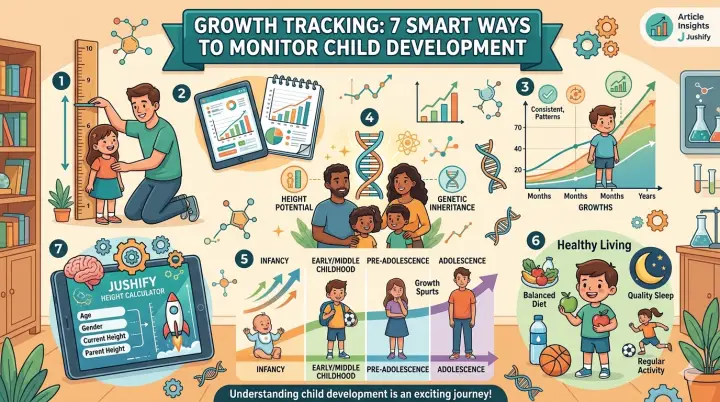
7 Smart Ways to Track Child Growth
1. Measure Height Consistently
One of the simplest ways to monitor growth is through regular height measurements.
Accurate measurements should be taken:
- Using the same method each time
- With proper posture
- At consistent intervals
Small differences in measurement technique can create confusion, so consistency is important.
Tracking height over time helps reveal whether a child is following a steady growth pattern.
2. Record Growth Changes Over Time
Keeping a growth record allows parents to see progress clearly.
A simple growth record may include:
- Date of measurement
- Child’s age
- Height
- Weight
- Notes about development
Long-term records provide more useful information than occasional measurements.
They help parents understand how growth changes throughout different childhood stages.
3. Understand Growth Patterns Instead of Single Numbers
One of the biggest mistakes parents make is focusing only on one measurement.
A child being shorter or taller than another child does not automatically indicate a problem.
Growth should be understood as a pattern.
Important questions include:
- Is the child growing consistently?
- Are changes happening over time?
- Does development match their growth stage?
Understanding patterns provides a more realistic view of development.
4. Consider Genetics When Tracking Growth
Genetics plays an important role in determining height potential.
A child’s growth pattern is influenced by inherited traits from both parents.
When tracking growth, parents should consider:
- Family height patterns
- Genetic background
- Development timing
This is why understanding genetics and child height is an important part of interpreting growth information.
A child may follow a growth pattern that reflects family characteristics rather than matching general averages.
5. Monitor Growth Through Different Development Stages
Children experience different growth phases throughout childhood.
Growth tracking becomes more meaningful when parents understand the child’s development stage.
For example:
- Infants usually grow rapidly
- School-age children often experience steady growth
- Teenagers may experience major growth changes during puberty
Age provides important context when interpreting height measurements.
This connection between age and development is why understanding child growth stages helps parents make better sense of growth tracking information.
6. Maintain Healthy Lifestyle Habits
Growth tracking is not only about measurements.
Healthy development also depends on daily habits.
Important areas include:
Nutrition
Balanced nutrition provides essential support for physical development.
Sleep
Proper rest supports recovery and healthy body processes.
Physical Activity
Regular movement helps maintain strong bones and muscles.
Tracking growth while maintaining healthy habits gives parents a more complete understanding of development.
7. Use Scientific Growth Tools
Technology has made growth tracking easier and more accessible.
Modern digital tools can help organize information and explain growth patterns in a simple way.
A scientific child height calculator can analyze multiple factors, including:
- Child’s age
- Gender
- Current height
- Weight
- Parent heights
Instead of looking at one measurement alone, these tools combine different inputs to estimate adult height using scientific calculations.
How Growth Tracking Connects With Height Prediction
Growth tracking and height prediction are closely connected.
Tracking provides valuable information about:
- Current development
- Growth speed
- Physical changes over time
Height prediction uses this information together with other factors to estimate future adult height.
A child’s growth history helps create a clearer understanding of development patterns.
However, prediction is not based on tracking alone. Scientific methods also consider genetics, age, gender, and other measurable factors.
How Modern Growth Tracking Uses Data Analysis
Traditional growth tracking relied mostly on manual records.
Modern approaches use technology and statistical analysis to make information easier to understand.
Advanced systems may analyze:
- Previous measurements
- Growth patterns
- Family height information
- Development stage
Statistical methods such as Linear Regression help identify relationships between different variables.
For example, a system can analyze how current height and parental height relate to future adult height estimates.
This data-based approach provides a more complete picture of growth.
The Role of Growth Charts in Tracking Development
Growth charts are commonly used tools for understanding child development.
They help compare a child’s measurements with general growth patterns from larger populations.
Growth charts can show:
- Height progression
- Weight changes
- Development trends
However, they mainly show where a child currently stands compared with typical patterns.
A height prediction tool has a different purpose because it focuses on estimating future adult height using multiple inputs.
Both approaches can provide useful information when understood correctly.
How Parents Can Avoid Common Growth Tracking Mistakes
Measuring Too Frequently
Children do not grow noticeably every day. Measuring too often can create unnecessary worry.
Focusing Only on Height
Growth includes many areas beyond height, including strength, coordination, and overall development.
Comparing With Other Children
Every child has a unique growth timeline.
Ignoring Long-Term Patterns
A single measurement does not represent a complete growth story.
Expecting Perfect Predictions
Growth estimates provide useful information but cannot guarantee an exact future outcome.
When Should Parents Pay More Attention to Growth Patterns?
Parents should pay attention when they notice unusual or unexpected changes in development.
Examples may include:
- Significant changes in growth pattern
- Concerns about overall development
- Questions about nutrition or health
If parents have concerns, consulting a qualified healthcare professional is the appropriate step.
Growth tracking is a helpful awareness tool, not a replacement for professional evaluation.
How Jushify Height Calculator Supports Growth Understanding
Modern growth tools can help parents better understand how different factors work together.
The Jushify Height Calculator analyzes:
- Parental height
- Child age
- Gender
- Current height
- Weight
Using scientific calculations and statistical analysis, it provides an estimated adult height based on the information entered.
The goal is not simply to provide a number but to help users understand the relationship between different growth factors.
By combining growth tracking information with scientific prediction methods, parents can gain a clearer picture of their child’s development journey.
Frequently Asked Questions
What is growth tracking?
Growth tracking is the process of monitoring a child’s physical development through measurements such as height and weight over time.
Why is growth tracking important?
It helps parents understand development patterns and observe how children grow through different stages.
How often should parents track child height?
Parents track growth periodically rather than measuring too frequently. Consistent long-term observation is more useful.
Can growth tracking predict adult height?
Growth tracking provides valuable information, but predicting adult height requires analyzing multiple factors, including genetics and development stage.
How does a child height calculator help with growth tracking?
A child height calculator combines growth-related information with scientific analysis to estimate adult height based on provided data.
Final Thoughts
Growth tracking is one of the most effective ways for parents to understand their child’s development journey.
By monitoring height changes, understanding growth patterns, and considering important factors like genetics and lifestyle, parents can gain valuable insights into childhood development.
Growth is a complex process influenced by many elements, and no single measurement tells the entire story.
Modern scientific tools make it easier to understand these patterns by combining data analysis with established growth principles.
When used correctly, growth tracking helps parents support healthy development while appreciating the unique path every child follows.