

Introduction
Watching a child grow is one of the most fascinating experiences for parents. From the first months of life to the teenage years, children go through remarkable physical changes that shape their development.
Many parents wonder why some children grow quickly during certain periods while others seem to grow gradually. The answer lies in understanding child growth stages.
Growth is not a constant process that happens at the same speed every year. Children experience different phases where their bodies develop, adapt, and mature. Each stage has unique characteristics that influence height, body structure, and overall development.
Understanding these stages helps parents recognize normal growth patterns and appreciate that every child follows an individual timeline.
Modern growth science also uses information from different development stages to better understand future growth. Factors such as age, current height, gender, and family genetics can help estimate an estimated adult height through scientific analysis.
What Are Child Growth Stages?
Child growth stages are periods of development where children experience specific physical and biological changes.
During these stages, the body undergoes changes related to:
- Height increase
- Bone development
- Muscle growth
- Hormonal changes
- Physical maturity
Each stage contributes differently to a child’s overall growth journey.
Some periods involve rapid growth, while others involve slower but steady development. Understanding these differences helps parents avoid unrealistic comparisons and focus on healthy progress.
Growth stages are closely connected with other important factors, including child growth factors such as genetics, nutrition, sleep, and lifestyle.
Why Growth Does Not Happen at the Same Speed
A common misunderstanding is that children should grow at a fixed rate every year.
In reality, growth speed changes throughout childhood.
For example:
- Babies grow very quickly during their first years.
- School-age children usually experience steady growth.
- Teenagers may experience significant growth spurts during puberty.
These changes happen because different biological processes become active at different times.
Growth patterns are influenced by:
- Genetics
- Hormones
- Development stage
- Health
- Environment
Understanding these natural differences helps parents better support their child’s development.
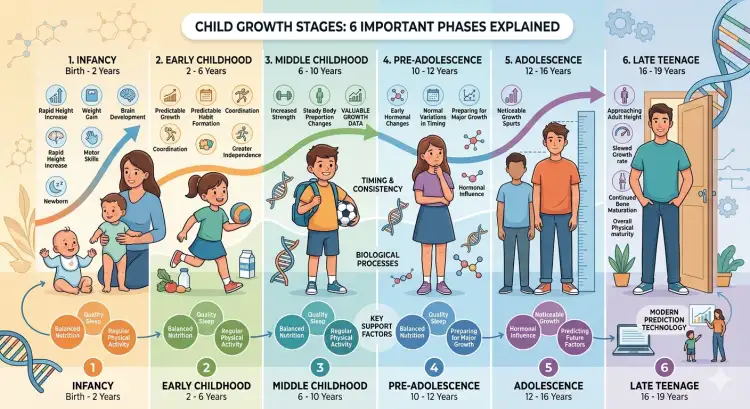
The 6 Important Child Growth Stages
1. Infancy Stage: Rapid Growth in the First Years
The infancy stage usually covers birth to around two years of age.
This is one of the fastest periods of human growth.
During infancy, children experience major changes in:
- Height
- Weight
- Brain development
- Motor skills
- Body coordination
Babies grow rapidly because their bodies are developing essential systems needed for life and movement.
Nutrition plays a particularly important role during this period. Adequate feeding and proper care support healthy physical development.
Although infancy growth is rapid, it does not determine final adult height alone. Many additional growth stages influence future development.
2. Early Childhood Stage: Building Foundations
Early childhood generally includes ages two to six years.
During this phase, growth becomes more predictable compared with infancy.
Children develop:
- Stronger muscles
- Better coordination
- Improved movement skills
- Greater independence
Height continues increasing steadily, although the dramatic growth speed seen during infancy usually slows.
This stage is important because children begin developing habits that support long-term health, including:
- Eating patterns
- Sleep routines
- Physical activity habits
Parents often begin comparing their child’s height with others during these years. However, children naturally grow at different speeds.
A child’s current height should always be understood in the context of their overall development.
3. Middle Childhood Stage: Steady Development Years
Middle childhood generally occurs between ages six and ten.
During this stage, children often experience consistent growth.
Important developments include:
- Increased physical strength
- Improved coordination
- Continued bone development
- Changes in body proportions
Children become more active during this period through school activities, sports, and daily movement.
This stage provides valuable information about long-term growth patterns because height measurements collected over time can show how consistently a child is developing.
Parents who monitor growth should focus on trends rather than individual measurements.
4. Pre-Adolescence Stage: Preparing for Major Changes
Pre-adolescence usually occurs around ages ten to twelve, although timing varies between individuals.
This stage acts as a transition period before puberty.
Children may experience:
- Early hormonal changes
- Physical differences
- Changes in body composition
- Increased growth activity
The timing of these changes differs among children.
Some children begin developing earlier, while others develop later. These differences are normal and are influenced by genetics and biological factors.
Understanding pre-adolescence is important because puberty timing can significantly affect future growth patterns.
5. Adolescence Stage: The Major Growth Period
Adolescence is one of the most significant stages for height development.
During puberty, many children experience noticeable growth spurts.
These changes are influenced by:
- Hormones
- Genetics
- Biological development
Boys and girls generally experience puberty-related growth changes at different times.
Girls often begin puberty earlier, while boys may experience their major growth period later.
Because adolescence varies greatly between individuals, predicting future height requires considering multiple factors rather than relying only on age.
Modern height prediction methods analyze development information alongside other inputs to estimate future adult height.
6. Late Teenage Stage: Approaching Adult Height
The late teenage years represent the final phase of major growth and development.
During this stage:
- Growth gradually slows
- Bones continue maturing
- Physical development approaches completion
The exact timing varies from person to person.
Some individuals complete most growth earlier, while others continue developing later.
By this stage, many of the factors influencing adult height have already played their role, including genetics, growth history, and development patterns.
How Growth Stages Affect Height Prediction
Understanding growth stages is essential when estimating future height.
A child’s age provides important context because the same height measurement can mean different things at different stages.
For example:
- A height measurement in early childhood may reflect early development.
- The same measurement during adolescence may indicate a different growth pattern.
This is why modern prediction methods consider age as an important factor.
A scientific child height calculator uses age together with other information such as:
- Gender
- Current height
- Current weight
- Parent heights
to analyze growth patterns and estimate adult height.
The Connection Between Genetics and Growth Stages
Growth stages do not happen independently from genetics.
Inherited traits influence:
- Growth timing
- Development patterns
- Height potential
Parents’ heights provide important genetic information, but the way a child grows through different stages also matters.
Understanding the relationship between genetics and child height helps explain why children from the same family may experience different growth journeys.
How Scientists Study Child Growth Patterns
Researchers study child growth by analyzing information from large groups of children.
They examine:
- Height measurements
- Age-related changes
- Gender differences
- Family genetics
- Development patterns
This research helps create models that explain normal growth and identify common trends.
Statistical methods, including Linear Regression, are often used in modern prediction systems to analyze relationships between different growth factors.
These methods help estimate future outcomes based on available information.
How Modern Technology Helps Parents Understand Growth
Technology has changed the way parents learn about child development.
Modern tools can organize growth information and provide easier ways to understand complex biological patterns.
A height prediction tool may analyze multiple factors together instead of focusing on only one measurement.
This approach helps parents understand how different elements contribute to estimated adult height.
Digital tools are especially useful because they make scientific concepts easier for everyday users to explore.
Common Mistakes Parents Make About Growth Stages
1- Comparing Children at the Same Age
Children do not all grow according to the same timeline.
One child may experience a growth spurt earlier, while another may develop later.
2- Assuming Faster Growth Means Greater Adult Height
A child who grows quickly at one stage does not always become the tallest adult.
Long-term growth depends on many factors.
3- Ignoring Development Patterns
Looking only at current height without considering age and growth stage can lead to misunderstandings.
4- Expecting Predictions to Be Perfect
Growth prediction provides an estimate based on available information. It cannot account for every future biological change.
How Parents Can Support Healthy Growth Through Every Stage
Parents can encourage healthy development by focusing on:
1- Balanced Nutrition
Provide a variety of foods that support normal growth and overall health.
2- Quality Sleep
Maintain healthy sleep routines because rest supports physical development.
3- Regular Physical Activity
Encourage movement, sports, and active play.
4- Positive Environment
Support emotional wellbeing and healthy habits throughout childhood.
A supportive environment helps children develop naturally through each growth stage.
Frequently Asked Questions
What are the main child growth stages?
The main stages include infancy, early childhood, middle childhood, pre-adolescence, adolescence, and late teenage development.
Why do children grow at different speeds?
Children grow at different speeds because of differences in genetics, hormones, development timing, and lifestyle factors.
Does age affect height prediction?
Yes. Age is an important factor because children experience different growth patterns at different development stages.
How does a child height calculator use growth stages?
A child height calculator considers age along with other factors such as gender, current height, weight, and parental height to estimate adult height.
Can puberty change future height predictions?
Yes. Puberty timing and growth patterns can influence development, which is why multiple factors are considered in height estimation.
Final Thoughts
Child growth is a journey that happens through several important stages, from infancy to adulthood.
Each stage contributes to physical development and provides valuable information about how children grow over time.
Understanding these phases helps parents recognize normal development and avoid unnecessary comparisons.
Modern scientific tools combine information from different growth stages with genetic and physical factors to provide meaningful insights into future development.
A well-designed child height calculator can help parents explore estimated adult height by analyzing multiple growth-related inputs.
The most important goal is not predicting every detail of the future but supporting children with healthy habits and a strong foundation throughout their growth journey.