Mattress Size Confusion Solved: Use This Chart & Comparison Tool

Selecting the perfect mattress often feels like navigating a maze of numbers and guesswork. You find a mattress size chart, see that a Queen is 60 by 80 inches, and try to imagine it in your room. You wonder if a King is worth the extra space or if a California King is right for your height. This common struggle stems from a critical gap: a mattress size chart gives you data, but it can’t provide true understanding. This is where a powerful Mattress Size Comparison Tool becomes indispensable, transforming abstract dimensions into clear, visual reality. This guide will show you how to leverage both the foundational chart and interactive comparison technology to make a choice you’ll be confident in for years.
Why the Standard Mattress Size Chart Is Only Half the Story
Every shopping journey starts with a mattress and bed size chart. These tables are essential references, providing the blueprint of standard dimensions. However, they have a significant limitation: they require you to translate numbers into a three-dimensional space in your mind. Can you accurately visualize how much larger 76 inches is than 60? Do you know what 84 inches of length looks like with a 6’4″ person lying down?
Relying solely on a mattress dimensions chart leads to common and costly mistakes:
- The Spatial Squeeze: Ordering a King based on its appealing specs, only to find it overwhelms your bedroom, leaving no walking space.
- The Dangling Feet Dilemma: A tall person using a standard chart picks a Full bed, only to discover the 75-inch length is far too short.
- The Couple’s Compromise: Two people choose a Queen to save space but endure years of disrupted sleep because the chart couldn’t convey the feeling of 30 inches of personal width.
A mattress size chart is the necessary starting point, but the journey to certainty requires a bridge from data to visualization. This is the exact gap a sophisticated Mattress Size Comparison Tool is designed to fill.
Your Foundational Blueprint: The Comprehensive Mattress Size Chart
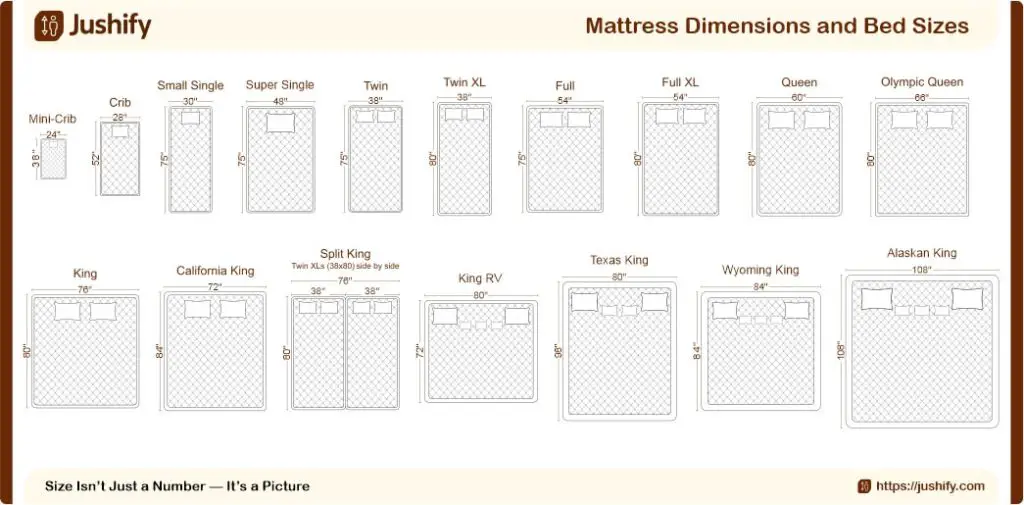
To build a confident decision, we must start with a reliable foundation. The following mattress size chart details the standard U.S. dimensions, serving as your essential data source for any comparison.
| Mattress Size | Dimensions (Inches) | Dimensions (Cm) | Best For / Key Notes | Minimum Recommended Room Size |
|---|---|---|---|---|
| Twin | 38″ x 75″ | 96.5 x 190.5 | Children, single adults in small rooms. | ~7 x 10 feet |
| Twin XL | 38″ x 80″ | 96.5 x 203.2 | Tall single sleepers; common in dorms. | ~7 x 10 feet |
| Full / Double | 54″ x 75″ | 137 x 190.5 | Single adults wanting more space; snug for two. | ~9 x 10 feet |
| Queen | 60″ x 80″ | 152.4 x 203.2 | The most popular couple’s size; balance of space and room fit. | ~10 x 10 feet |
| King | 76″ x 80″ | 193 x 203.2 | Couples wanting maximum personal space (38″ each). | ~12 x 12 feet |
| California King | 72″ x 84″ | 182.9 x 213.4 | Best for tall individuals (over 6’2″); longer but narrower than a King. | ~12 x 12 feet |
How to Actively Use This Mattress Size Chart: Pay close attention to the “Minimum Recommended Room Size.” This crucial column adds the necessary context of walking space (2-3 feet around the bed) that a raw mattress dimensions chart often misses. It is the first step in moving from numbers to a feasible room plan.
Bridging the Gap with a Mattress Size Comparison Tool
So, how do you cross the chasm between seeing that a Queen is 60×80 inches and knowing it’s right for you? The answer lies in interactive visualization. A Mattress Size Comparison Tool acts as your translator, converting the blueprint from the chart into an interactive, true-to-scale model.
Think of it this way: if the mattress size chart is your map, the comparison tool is your real-time GPS navigation. It allows you to move from passive reading to active exploration, solving the core visualization problem.
The Step-by-Step Process of Visual Comparison
Using a top-tier Mattress Size Comparison Tool involves an intuitive process that mirrors natural decision-making:
- Input from the Blueprint: Begin by selecting sizes directly from the tool’s integrated mattress size chart. Choose ‘Queen’ and ‘King’ to tackle the most common couple’s dilemma.
- Instant Side-by-Side Analysis: The tool renders both mattresses to perfect scale on a gridded floor plan. The 16-inch width difference is no longer just a number; it’s a visible, tangible strip of space.
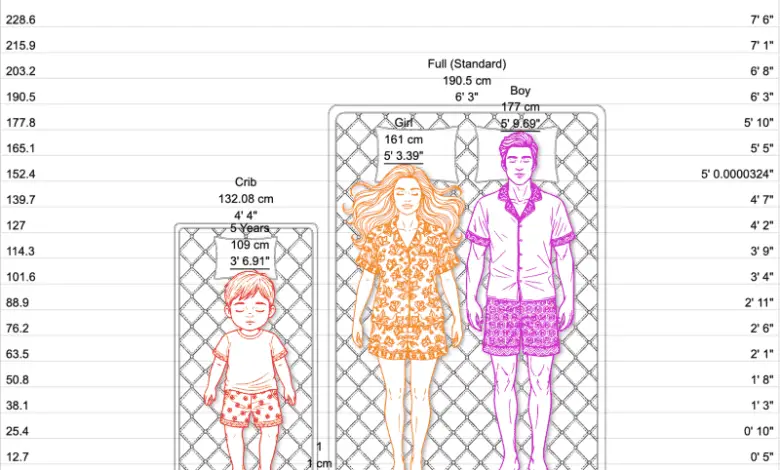
- Adding Real-World Context (The Game Changer): Here’s where static data becomes dynamic. Add human silhouettes. Input specific heights (e.g., 5’6″ and 6’0″) and place them on each mattress. You no longer just see the bed—you see the experience. The visual instantly shows the difference in personal territory.
Solving Real-World Dilemmas Through Visual Comparison
Let’s apply this powerful combination of chart and tool to common dilemmas that numbers alone can’t solve.
Dilemma 1: “King vs. California King: Which is Actually Better for Me?”
The mattress size chart shows one is wider, the other longer. But what does that feel like?
- The Visual Test: Pull both into your Mattress Size Comparison Tool. Add a silhouette set to 6’4″. On the California King, they fit with clear space at the feet. On the standard King, their feet are at the very edge. For a tall sleeper, this visualization makes the “length vs. width” trade-off obvious and immediate.
Dilemma 2: “Will a Queen Be Too Small for Us as a Couple?”
You know you need more space than a Full, but is the jump to King necessary?
- The Visual Test: Compare Queen and King in the tool. Add two silhouettes. Have them stretch out. The visual will starkly reveal the difference in personal “territory.” This concrete evidence is far more persuasive than any sales description.
Dilemma 3: “I Have a Non-Standard or Old Bed. How Does It Compare?”
The tool’s custom input feature is perfect for solving a very common real-world problem: understanding how unique or inherited furniture stacks up against modern standards.
- The Visual Test: Simply use the tool’s “Custom” function to input the exact dimensions of your unique bed (e.g., an heirloom frame that’s 58″x78″, or a custom RV mattress). Compare it side-by-side with a standard Queen (60″x80″). Then, add human silhouettes scaled to your family’s heights. In seconds, you get a clear visual answer: Is your current bed providing enough sleeping space, or would an upgrade to a standard size deliver a meaningful improvement in comfort for your body?
Beyond the Purchase: Extended Benefits of a Comparison Tool
The power of a robust Mattress Size Comparison Tool extends far beyond the individual shopper.
- For Interior Designers: It provides a client-presentation-ready visual to justify furniture layouts, eliminating “I thought it would fit” disputes.
- For Mattress Retailers: Embedding such a tool on product pages dramatically reduces hesitation and returns, as customers achieve certainty before clicking “buy.”
- For Families: Planning a child’s transition from a Twin to a Full? Visualize the new bed’s footprint with the existing furniture, making space planning simple and collaborative.
Conclusion: From Data to Decisive Confidence
The traditional mattress size chart is not obsolete; it is the essential, authoritative dataset. However, it represents the beginning of the journey, not the end. The final step—the step that guarantees confidence and prevents regret—is visual translation.
By strategically using a Mattress Size Comparison Tool, you empower yourself to make decisions based on simulated reality, not numerical guesswork. You move from asking, “I think this should fit?” to declaring, “I know this will fit.” In an era of visual technology, applying this clarity to the most important piece of furniture in your home isn’t just an advantage—it’s the key to perfect rest.
Consult the chart for your foundational data, but use the comparison tool for your ultimate size clarity.
Frequently Asked Questions (FAQs)
I have an old, non-standard mattress. Can I compare it to a new size?
Absolutely. A good Mattress Size Comparison Tool will have a “Custom” feature. Input your old mattress’s exact dimensions and place it side-by-side with a modern standard size to see the exact difference in real scale, bridging the gap between your old chart and new options.
How accurate are the human silhouettes in these comparison tools?
The human silhouettes are highly accurate for visualizing fit because they are proportionally scaled using average height data from the Centers for Disease Control and Prevention (CDC) growth charts.
Can I use these tools for international mattress sizes?
Yes, this is a key strength. Since you can input custom dimensions, you can enter the exact metrics for a UK King (150cm x 200cm) or a European Double (140cm x 200cm) and compare it directly to a U.S. Queen. This solves the major problem of differing size names across regions that a single mattress size chart can’t address.
Do I need to download software to use a mattress comparison tool?
No. Modern tools like Jushify’s are typically web-based applications that run directly in your browser (like Chrome or Safari), requiring no downloads and accessible from any device, making mattress size comparison incredibly convenient.