
The Smartest Way to Compare Car Sizes Before You Buy
Car Size Comparison Tool

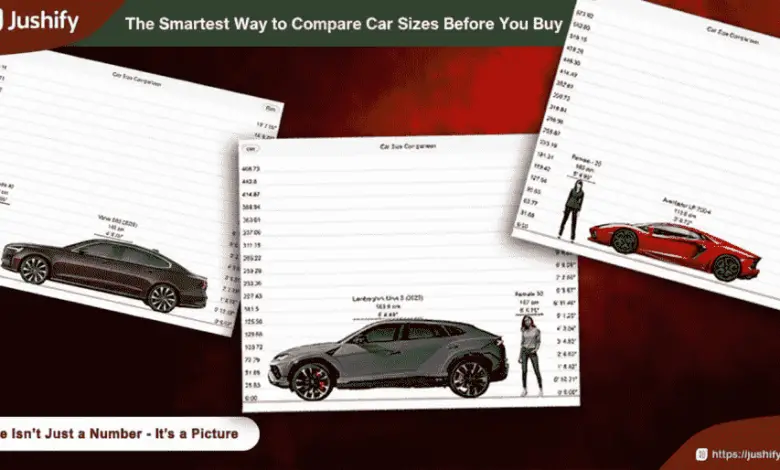
Buying a car is one of the biggest purchasing decisions most people make. Buyers spend weeks — sometimes months — researching engine performance, fuel economy, technology features, and safety ratings. But despite all this preparation, many people overlook one of the most important factors that affects everyday comfort and satisfaction: the actual physical size of the car.
Not the numbers listed in the spec sheet — but how big the car truly feels in the real world.
This is where visual car size comparison becomes essential. Instead of relying on confusing measurements, modern tools now allow buyers to compare cars side by side visually, helping them understand vehicle size instantly.
One of the most effective solutions available today is the Car Size Comparison Tool by Jushify, which allows users to visually compare vehicles using accurate scaling and real-world reference.
This simple shift — from numbers to visuals — can completely change how you choose your next car.
Why Car Size Is More Important Than You Think
When buyers think about car size, they often focus only on categories like:
- Sedan
- SUV
- Hatchback
- Truck
But these categories don’t tell the full story.
Two SUVs can feel completely different in size. One may feel compact and easy to drive, while another may feel tall and bulky. Even small differences in height can significantly affect:
- Driving confidence
- Parking convenience
- Passenger comfort
- Accessibility for children or elderly passengers
- Road presence
Unfortunately, spec sheets rarely communicate these differences clearly.
A number like 1,700 mm height means very little without context.
Is that tall?
Is that average?
Is that low?
Without visual comparison, most buyers are simply guessing.
The Problem with Traditional Car Comparison Methods
Traditional comparison methods rely heavily on numbers.
You’ll see tables filled with:
- Height
- Length
- Width
- Wheelbase
While these measurements are technically accurate, they are difficult for the human brain to visualize.
Most people cannot imagine what a difference of 100 mm looks like in real life.
This leads to common buyer mistakes, such as:
- Buying a car that feels too large
- Buying a car that feels too small
- Choosing a vehicle that doesn’t match expectations
Many buyers only realize the difference after seeing the car in person.
At that point, it’s often too late.
Visual Car Size Comparison: A Better Approach
Humans understand size best through visual comparison.
When two cars are placed next to each other, the difference becomes instantly clear.
You don’t need to calculate.
You don’t need to imagine.
You simply see.
Visual comparison helps answer important questions, such as:
- Which car is taller?
- How much bigger is an SUV than a sedan?
- Does the car feel compact or large?
- How does it compare to your current vehicle?
This is why visual car size comparison tools are becoming increasingly popular among car buyers worldwide.
What Is a Car Size Comparison Tool?
A Car Size Comparison Tool is a visual platform that allows users to compare vehicle sizes using scaled images.
Instead of reading numbers, users can:
- Place cars side by side
- Compare vehicle height visually
- See real-world size differences
This makes it easier to understand vehicle proportions and presence.
It transforms abstract numbers into clear visual information.
Compare Cars Side by Side for Better Decisions
One of the biggest advantages of visual comparison is the ability to compare cars side by side.
This allows buyers to evaluate:
- Compact SUV vs full-size SUV
- Sedan vs SUV
- Electric car vs gasoline car
- Sports car vs regular car
When vehicles are shown next to each other, buyers can quickly see:
- Which car is taller
- Which car feels bigger
- Which car matches their needs
This removes uncertainty and improves confidence.
Compare Cars with Human Height for Real-World Perspective
One of the most powerful features of modern comparison tools is the ability to compare vehicles with human height.
This provides real-world context.
For example, buyers can see:
- How tall the car is compared to an average person
- Whether passengers can enter comfortably
- How high the roofline feels
This is especially useful for:
- Families with children
- Elderly passengers
- Short or tall drivers
Human comparison makes vehicle size easier to understand than numbers alone.
Why This Matters for SUV Buyers
SUV popularity has grown rapidly worldwide.
Many buyers choose SUVs for:
- Higher driving position
- Better visibility
- More space
But SUVs vary greatly in size.
Some SUVs are only slightly taller than sedans.
Others are much larger.
Without visual comparison, buyers may not understand these differences.
Visual comparison ensures buyers choose the right size SUV.
Car Size Comparison Is Essential for Electric Vehicles
Electric vehicles often have different proportions compared to traditional cars.
Battery placement affects:
- Floor height
- Cabin height
- Overall vehicle stance
Some EVs may appear compact but feel tall.
Others may appear large but sit lower.
Visual comparison helps buyers understand these differences clearly.
This is especially important as EV adoption continues to increase globally.
Useful for Car Enthusiasts and Researchers
Car size comparison is not only useful for buyers.
It is also valuable for:
Car enthusiasts
Automotive bloggers
Researchers
Students
Designers
They can study:
- Design trends
- Size differences across generations
- Vehicle evolution
Visual tools make analysis easier and more engaging.
Helps Families Choose Practical Cars
Families often prioritize comfort and accessibility.
Car size affects:
- Child seat installation
- Ease of entry
- Passenger comfort
Visual comparison helps families make practical decisions.
They can see which vehicle best suits their needs.
Compare Cars from Different Brands Easily
Another major advantage of visual tools is cross-brand comparison.
Buyers can compare vehicles from different manufacturers, such as:
Toyota vs Honda
Tesla vs BMW
Audi vs Mercedes
This allows unbiased comparison based on size alone.
Marketing claims don’t influence the result.
Only physical dimensions matter.
Visual Comparison Saves Time During Research
Car research can be time-consuming.
Buyers often visit multiple websites and read countless reviews.
Visual comparison simplifies this process.
Instead of reading numbers, buyers see instant results.
This speeds up decision-making.
It also makes research more enjoyable.
Reduces Buyer’s Regret
One of the biggest causes of buyer regret is unexpected vehicle size.
Some buyers feel their car is too big.
Others feel it is too small.
Visual comparison reduces this risk.
Buyers know exactly what to expect.
This leads to higher satisfaction.
Helps Understand Real-World Vehicle Presence
Vehicle presence affects driving experience.
Some cars feel dominant.
Others feel subtle.
Height plays a major role.
Visual comparison shows presence clearly.
Buyers can choose a car that matches their preference.
The Future of Car Comparison Is Visual
As technology evolves, car comparison methods are improving.
Visual tools represent the future.
They are:
Faster
Clearer
More intuitive
More useful
They match how humans naturally understand size.
More buyers are adopting visual comparison tools every year.
Who Should Use Car Size Comparison Tools?
These tools are useful for:
Car buyers
Car enthusiasts
Automotive bloggers
Researchers
Students
Families
Anyone interested in vehicle size can benefit.
Why Visual Comparison Is More Reliable Than Guessing
Guessing vehicle size based on numbers is unreliable.
Visual comparison provides clarity.
It removes uncertainty.
It improves decision quality.
This makes it an essential step in car research.
Final Thoughts
Car size plays a critical role in comfort, safety, and satisfaction.
Yet it remains one of the most misunderstood aspects of car buying.
Traditional comparison methods rely too heavily on numbers.
Visual comparison solves this problem.
By allowing users to compare cars side by side and see real-world size differences, modern tools help buyers make smarter decisions.
Before choosing your next car, don’t rely on numbers alone.
Make sure you see the difference.
Because when it comes to car size, visual understanding changes everything.